

A mother told me recently how frustrated she was with her ten-year-old son.
He wouldn’t sit still. She had to ask him several times to do just about anything. And lately he seemed irritated by almost everything she said.
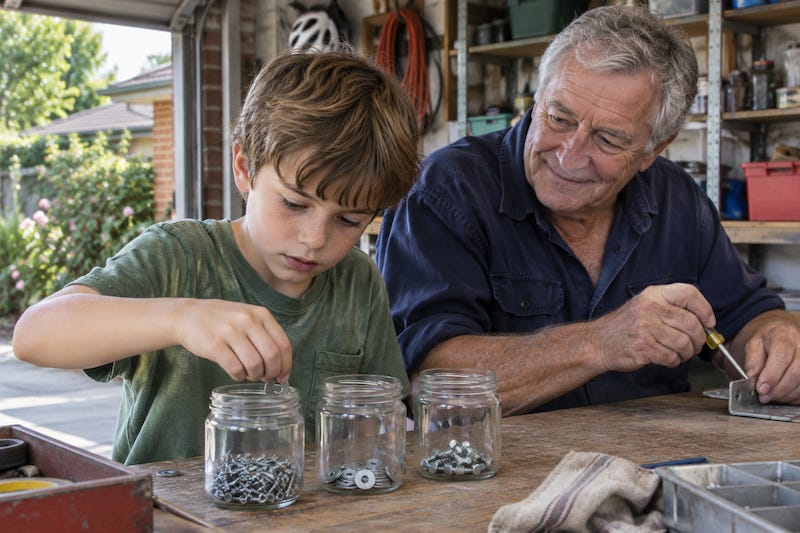
Then one Saturday she found him in the shed with his grandfather. He’d spent forty minutes happily sorting screws and bolts into jars.
What was that about, she wondered?
It could be as simple as enjoying time with Grandad. That’s worth paying attention to in itself. It could also be that the job suited him. He had something to get his hands on, a problem to work out and someone beside him who let him get on with it.
I suspect it was something more than that.
This mother was given a glimpse into what her son was really built for.
Discovering this has massive implications for her son’s future success, wellbeing and identity. It will also change how she sees and parents her son.
Three questions to help you spot The Natural Fit
I call it The Natural Fit when a child’s talents, temperament and the things they’re drawn to come together.
Here are three questions that can help you see it.
1. What can my child do well?
Look at what they do in ordinary moments.
The boy in the shed might have an eye for small differences.
A child who makes up a treasure hunt might be good at judging how tricky a clue needs to be for a younger cousin to work out.
Look beyond the activity itself to recognise the talent that sits behind it.
2. How does my child like to go about things?
Some kids like to talk their way through a job.
Others want to have a go quietly before anyone asks them to explain what they’re doing.
The boy in the shed might like working alongside someone, with plenty of room to make his own decisions.
The way kids approach a task often reveals as much about their temperament as the task itself.
3. What does my child keep coming back to?
Notice what they choose when they have some time to themselves.
Does your child keep pulling things apart to see how they work?
Do they make up games for other kids?
Do they spend half the holidays drawing maps of places they’ve invented?
What kids repeatedly choose to do, without encouragement or prompting, offers clues to their natural inclinations.
The three questions are most useful together.
Take two kids who are good at telling stories.
One loves making people laugh and gets his best ideas when someone at the dinner table says, “And then what happened?”
The other loves inventing characters and takes her time drawing their adventures. Ask both kids to tell a story at a family gathering, and you’ll probably spot the first child’s talent straightaway. To see what the second can do, ask to read the comic she’s been working on all week.
Both kids have a talent for storytelling, but their different temperaments and interests shape how that talent finds expression. Understanding all three helps you provide the experiences and opportunities that bring out the best in each child.
Help your child see it too
It’s one thing to recognise your child’s Natural Fit. It’s another to help them recognise it for themselves.
Young children need us to notice and name what comes naturally to them. As kids get older, we can help them make their own connections between what they’re good at, how they like to operate and what they enjoy.
The aim isn’t to steer them in a particular direction or have them work out what they want to do in life.
It’s to help them develop the self-knowledge that will inform the choices they make as they grow.
1. Ask about the part they enjoyed.
“You were out in the shed for ages. What was the best bit?”
If your son says he liked helping Grandad find the right bolts, give him another chance to work alongside Grandad. If he says he wanted to see whether he could get everything sorted, ask if he’d like to work out where things go in the family toolbox.
Questions like these encourage kids to think about why they enjoy certain activities, rather than simply identifying what they like doing.
Give them another chance to use the same ability.
If your daughter loved making up tricky clues for her cousins, ask if she’d like to make a treasure hunt for someone’s birthday.
See which part she takes charge of.
She might spend most of her time working out what will make each cousin laugh or how to keep the youngest one in the game.
Using an ability in different settings helps kids recognise they have a talent they can use in a variety of ways.
Tell them what you saw.
“You made that last clue easier when you saw Ben getting stuck. That kept him in the game.”
Your observations give kids a language to describe their emerging strengths and a greater appreciation of what they have to offer.
Finally…
As parents, we spend a great deal of time helping kids get better at things they find difficult. We need to devote just as much attention to discovering what comes naturally to them.
Over the next few weeks, look for those moments when your child is absorbed, capable or surprisingly enthusiastic. Use the three questions to make sense of what you see, then give your child more opportunities to explore what seems to fit.
Resist the temptation to turn every emerging talent into a lesson, an organised activity or an achievement to pursue. Give kids room to discover things about themselves without the pressure to excel.
The Natural Fit is as much about changing the way you see your child as it is about helping your child see themselves.
Rather than continually asking, “What does my child need to get better at?” make room for another question:
“What might my child be naturally built for?”
Over to you…
Think of a recent moment when your child surprised you with their ability, enthusiasm or capacity to concentrate.
What were they doing? What might it tell you about their Natural Fit?
I’d love to hear your observations. Share your story in the comments or reply directly to this email. Your experiences will help shape future articles about The Natural Fit.
Turn parenting insights into action
Reading about parenting change is easy. Putting it into practice is harder.
Join the growing group of readers who’ve become paid Parenting Toolbox members and gain access to practical toolkits, mini-kits, and member resources that help you turn the ideas you read about into everyday parenting practices.