

I like the idea of the Growth Mindset.
That is, the belief that your basic abilities and intelligence can be developed over time through effort and persistence.
But I don’t love it.
The idea that you can become good at anything has merit.
But it neglects the fact that there’s a tax to pay when you pursue it.
My work with many kids and my experience with my children have shown that they pay a high mental health tax to develop in areas that nature hasn’t designed them for.
For many kids, anxiety and growth mindset are soulmates.
I’m not suggesting that we have sold a lie by Carol Dweck, the creator of the Growth Mindset.
It’s a smart concept that opens doors for many kids, when the previous notion of a fixed mindset -“I’m not good at math/sport/cooking”- let too many kids off the hook. It was a convenient excuse for not trying.
Kids can excel in areas where they're not naturally talented, but the cost to mental health and the opportunity cost of neglecting their true strengths needs to be factored in.
It is better to look for their Natural Edge, which is found at the intersection of talent, interests and personality.
That is, where natural, sustainable strengths lie and where the tax kids pay is minimal, if any.
What is Your Child Built for?
A child’s Natural Edge is found at the intersection of their natural abilities, their interests and their personality.
That is where we should focus, rather than steering them towards directions they are not built for.
Parents, quite naturally, have high expectations for their kids, but those expectations are often skewed toward the areas they value. Professionals tend to push kids toward the professions. Sporty parents love it when their kids are sporty too. And parents who value the arts smile when their child picks up a paintbrush, goes to ballet classes or takes up the piano.
Meeting parental expectations is a strong driver, especially for approval-seeking firstborns, which can lead them down a path that they are not designed for.
Experience tells me that approach often doesn’t end well.
Better to help your child find their natural edge when they are young.
The clues are there. Right in front of you.
You just need to know where to look.
Discovering Your Child’s Natural Edge
These four markers or clues will help you discover your child’s Natural Edge - that is, what they are built for in terms of ability, interest and psychological fit. They are:
1. The Flow State
This is the easy effort indicator.
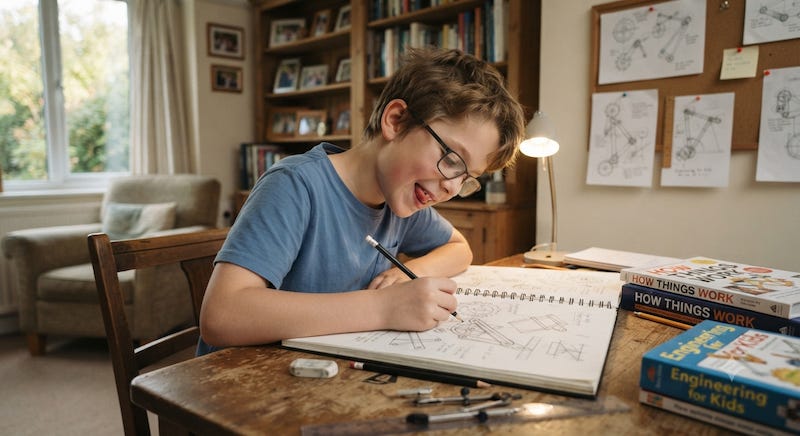
Flow occurs when a child is so deeply immersed in an activity that they lose track of time and their environment.
It is the sweet spot where the challenge level perfectly matches their current ability. This happens when you call your child for dinner, only to find them completely absorbed in an art activity.
They haven’t heard you call their name three times because they are entirely in the zone, finding the process of drawing more rewarding than the finished product.
2. Natural Gravity
This is the magnetism test.
Look for the activities your child gravitates when they’re left to their own devices.
When they have free time and no external pressures or schedules, they are naturally pulled toward activities that feel intrinsically right.
For instance, a child who consistently heads outside to organise a game of soccer with their friends or spends their afternoon meticulously mapping out a mountain bike track in the local park is developing their natural edge.
This is a child naturally drawn to the mechanics of strategy or movement without being prompted.
3. Relief
Watch for the exhale.
When a child engages in an activity that suits their temperament and ability, there’s a visible drop in tension.
They aren’t just performing; they are feeling like themselves.
You might see this after a long day of school, when your child drops their bag and immediately heads to the garage to tinker with a bike or spends an hour quietly building intricate models.
Their shoulders drop, their breathing slows, and they find a restorative sense of rightness in the task, rather than experiencing it as another chore to complete for a mark or a school project.
4. The Early Echo
Look for the recurring themes from a child’s early years—the interests or behaviours that appeared before they learned how to seek approval or perform for others.
This echo is your child’s real self appearing before the layers of social expectation were added, much like a child who, at age four or five, was always trying to mediate arguments between their stuffed animals.
Now, as primary or secondary school-aged kids, they are naturally stepping into roles as conflict negotiators or team captains; the leadership trait was always there; it just needed time to mature.
This marker is perhaps the most potent indicator of your child’s Natural Edge.
Finally
Finding a child’s Natural Edge is about working out who they are, rather than moulding them into who we think they should be.
For many parents it involves a mindset change away from developing a child’s talents in a single area at any cost to observing their natural inclinations when the pressure to perform has been removed.
By focusing on these markers, you can help your child channel their unique abilities and personality, building a sustainable and fulfilling foundation. You also alleviate the heavy mental health tax that comes from trying to be someone they aren’t.
The goal of discovering their Natural Edge isn’t just to make them successful at any cost; it’s to help them uncover the physical, cognitive and psychological gifts that nature gave them, providing a them with a platform for success that will last a lifetime.
Want to learn more about (discovering and maximising) your child’s Natural Edge?
The Natural Edge is my next major project. In fact, it looks like it’s going to be my next book, but that’s a story for another day.
Over the coming months, I’ll be researching and developing, in depth, the tools and strategies you can use to bring your child’s Natural Edge to the fore. I already have developed some strong frameworks that I’m busting to share with you.
From time to time, I’ll be sharing my findings, frameworks, and strategies in Parenting Toolbox under the heading: Natural Edge. You’ll also be able to find these articles under Natural Edge in the Parenting Toolbox homepage.
And yes, it’s free for everyone to read.
In the meantime, I’d appreciate it if you could do two things:
First, share this newsletter with another parent, friend, colleague or professional (in education or psychology). Sharing is easy.
Second, answer the question below. It will help me ascertain if there is an appetite for this topic. Please note that no record of your details or reply is kept.
I appreciate your assistance, and I look forward to sharing more with you over the coming months about The Natural Edge.
In the meantime, I’ll still be sharing in Parenting Toolbox the same high quality tools, tips and strategies about the broader parenting areas as I’ve covered in the previous three years.
You won’t miss a thing.
Many thanks,
Michael