

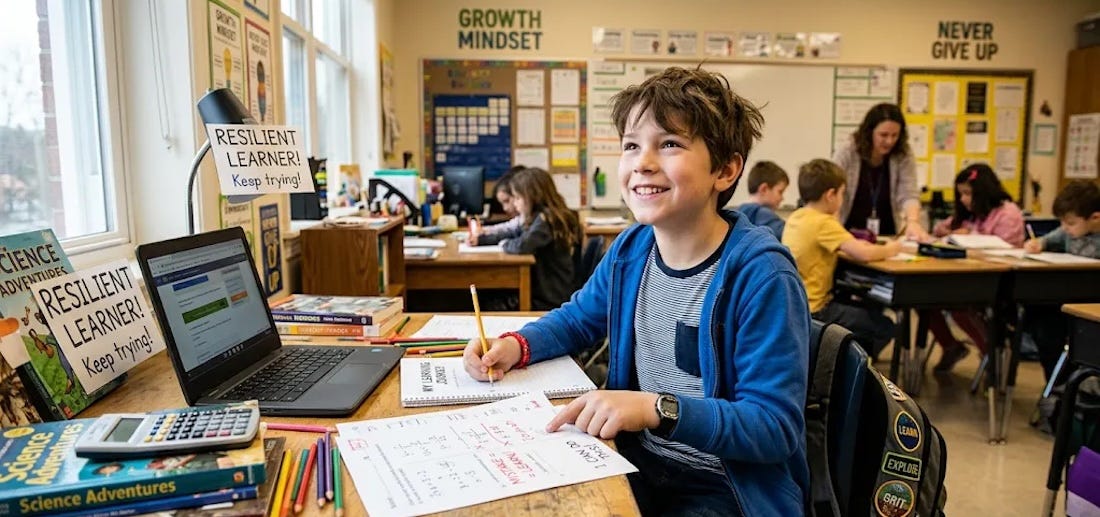
I’ve never a met a parent who doesn’t want their child to do well at school.
But sometimes their focus is wrong.
It’s all about results, which isn’t the best indicator of success.
Doing well at school isn’t just about grades.
True, long-lasting success is found in academic resilience, which empowers students to thrive despite challenges.
When facing setbacks, the growth mindset for kids often wavers, leading to avoidance.
“I’m not good at spelling, reading, or math’ often becomes their default reply, which helps them avoid taking learning risks. It also acts as a convenient defence mechanism to protect their self-esteem, but it severely restricts their potential.
However, by intentionally teaching perseverance at home, you can transform these moments into learning opportunities.
The development of a resilient learner helps ensure long-term learning success- way beyond your child’s current classroom.
It builds the emotional stamina necessary for life’s complexities.
By implementing practical strategies for student success, you ensure your child not only navigates the school year but also gains the confidence to tackle any hurdle.
You help them understand that intelligence is dynamic, not fixed, allowing them to view obstacles as temporary rather than permanent limitations.
This is why cultivating resilience is the most important gift you can give a primary-aged student; it builds the stamina they need to navigate not just the school year, but the complexities of life itself.
What is Resilience and Why Does It Matter?
Academic resilience is the capacity to maintain a positive, productive approach to learning, even when things become difficult.
It isn’t about being tough or ignoring feelings of disappointment; it’s about having the emotional tools to work through difficult feelings and find a solution.
This is vital in the early years of primary school, when children begin to form their identities as learners.
If they equate success only with being the smartest or the fastest, they will crumble the moment they encounter a task that doesn't come easily.
As psychologist Carol Dweck famously noted:
"The view you adopt for yourself profoundly affects the way you lead your life. It can determine whether you become the person you want to be and whether you accomplish the things you value."
Resilience acts as a buffer against anxiety.
It allows a child to stay engaged, ask for help, and ultimately, find satisfaction in the effort of learning, not just the result.
Shaping a Resilient Learner at Home
As a parent, you are the architect of your children's learning environment. Here are some ideas to help you shape the psychological environment that builds resilience needed for learning:
1. Praise the Process, Not the Talent
When your child brings home a great result, resist saying, "You’re so clever!"
Instead, try, "I noticed how hard you worked on that draft," or "You really stuck with that math problem until you figured it out."
By focusing on effort, you teach them that their hard work drives results rather than their natural ability.
2. Normalise the Struggle
Don’t jump in to rescue your child the moment they feel frustrated.
When they hit a wall, encourage them to sit with the struggle for a moment to build the tolerance required for deeper learning.
This small pause allows their brain to switch from emotional reactivity to logical problem-solving.
3. Model Your Own Fails
Children are acute observers of everything we do, including how we handle our own mistakes.
Use this to your advantage to teach them how you approach challenges.
If you are struggling with a project, talk through your thought process aloud: "This is frustrating, but I’m going to take a break and try a different approach. First, I need to make a list, then……”
Hearing you articulate your strategy gives them a roadmap to follow when they hit roadblocks.
4. Encourage “Yet”
If your child says, "I can’t do this," add the word "yet” to the end of the sentence.
It’s a small linguistic shift that opens the door to growth and reframes the current challenge as a temporary hurdle rather than a permanent limitation. It’s also something you can try yourself, when you’re tempted to say in frustration, “I just can’t do this……. yet!”
5. Create a Supportive Debrief Ritual
Instead of just asking, "How was your day?", ask, "What was the most challenging thing you encountered today, and what did you learn from it?"
This regular check-in normalises the idea that challenges are a healthy, everyday part of learning and helps children develop the reflective capacity needed to overcome future obstacles.
Final thoughts
Building a resilient learner doesn't happen overnight; it is a gradual process of shifting focus from the destination to the journey.
By normalising struggle, celebrating effort over innate ability, and encouraging self-leadership, you empower your children to face the academic world with confidence.
The goal isn't to prevent your child from failing, but to ensure they have the courage and tools to bounce back stronger every single time.