

I published this article two years ago, almost to the day, when I was in Sweden visiting my son and his family. At that time, I had fewer than 50 subscribers on Substack. Now, with over 7,100 subscribers, I’ve republished it, as it may be read by a few more readers!
Why read?
Simply, there’s a lot to learn from how different cultures parent, and the Swedes are very grounded with the way they raise their kids.
Besides, I’ve kept it short so it won’t take much of your time. Win-win!
Enjoy the learning.
I’m currently spending time in Sweden with my son and his family. I’m struck by how differently children are raised here, than they are in Australia and other English-speaking countries.
This is my sixth trip in six years, so I’ve had a chance to experience the culture, the education scene, and the way kids are raised.
Many factors impact parenting, including climate, geography, family size, housing and politics.
Most Swedes have adapted well to any limitations imposed on them by, say, climate or geography, and they make the most of their advantages in all areas of life, including how they raise their kids.
Here are five Swedish parenting strengths that have become evident during my time here.
1. Swedish kids spend a lot of time outdoors
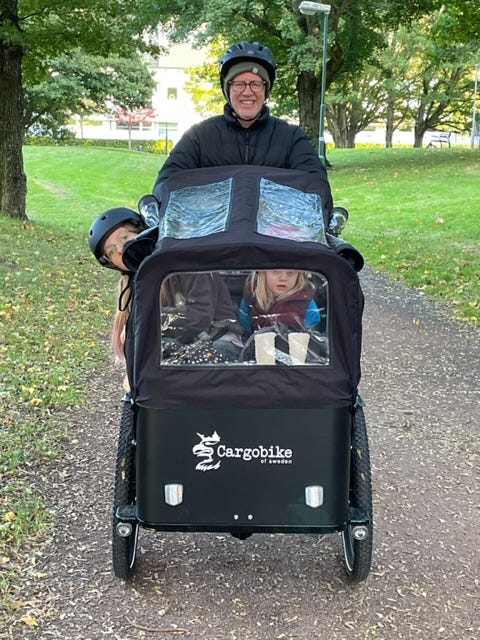
Walk through any city or town mid-week and you’ll see young children in coloured vests in parks, shopping centres or huddled together in cargo bikes, with an adult madly pedalling away.
Summer or winter, it doesn’t matter. Kids will be outside, whether on a child care excursion, a school trip, or after-school play. They dress for the weather.
In winter, layers of clothing go under an outer coat, waterproof gear, and a beanie.
In summer, the options are endless.
There’s a sense of stoicism in the Swedish approach to their harsh climate. Their kids are expected to embrace the cold rather than hide away at home when the weather is a chilly, wet or windy.
We can learn a lot from the Swedes’ stoic attitude towards kids and the natural elements.
Embrace the elements rather than hide away.
2. Swedish families integrate mental health practices into everyday life
Swedish people have adopted many practices that many developed countries now consider normal preventive mental health measures. The most common one is their use of saunas.
Communal saunas play a big role in Swedish culture, unlike in countries like Finland, where saunas tend to be more private.
A visit to a Swedish sauna is a communal affair. They go in groups or meet up with friends at the local sauna.
There can be so much chatter in a sauna that it’s common to set one aside for people who like to sweat in silence.
I love the fact that Swedes combine the physical benefits of saunas with the social and mental health benefits of community.
Saunas are merely the headline act in a long list of positive mental health activities - including mindfulness, exercise, and play which are integral to family life in most areas of Sweden.
3. After school activities are linked to enjoyment, not success
If there’s one Swedish trait I’d love to see adopted in Australia (and other English-speaking countries), it’s their intense focus on encouraging hobbies and interests in children and young people that boost their wellbeing and quality of life.
In my neck of the woods, we still tend to choose after-school activities for their educational value or successful outcomes.
Crafts, music, dance, sport and other hobbies are heavily subsidised by the central government in Sweden, so there are no financial barriers to involvement.
For example, ice skates and skating lessons are free for kids in my son’s hometown of Malmö, so skating is on the agenda for everyone.
Yep, there’s a theme here — outdoor activities, mental health focus, and community are at the heart of Swedish family life.
4. Swedish kids live locally, but think globally
You’d think that growing up in a sparsely populated country, speaking a language shared by no other nationality, would lead to insularity and inwardness.
Quite the contrary.
Swedish kids have a sophistication and confidence that’s born from the fact that they all speak a second language (English).
A good number have a third language (German), while many understand a fourth language - Danish - as Denmark is just across the Øresund Strait.
Swedes are taught from a young age that they may work in Germany, Denmark, England, or elsewhere, so they should adapt and look beyond their borders.
5. Swedish kids matter
The science of ‘mattering’ has fascinated me for some time.
‘Mattering’ relates to how a group or society values another group and how that group can add value to the community.
In this case, ‘mattering’ refers to how society values children and how kids can contribute to society.
There’s more expected from Swedish kids than from kids in my country.
In Sweden there’s a palpable expectation that kids help at home, volunteer at school, and pitch in at community events.
Certainly, from the outside it appears that Swedish society values kids far more than many other countries I’ve visited and lived in.
Importantly, Sweden has a plethora of rituals and traditions specifically aimed at younger generations.
Okay, there’s Halloween and Christmas, but they have so many more traditions and gatherings that link children to their communities and help them understand their past.
Most Swedes would tell me to keep my feet on the ground
It’s dangerous to generalise and easy to get carried away with a point of view.
I’m not suggesting that Sweden is the promised land of parenting.
No, it’s hard work here, and parents (and teachers) have their problems, just as they do in other countries.
But there are some fascinating parenting patterns here that parents in other countries could do well to adopt, or at least consider.
Swedes are remarkably pragmatic and renowned for keeping their feet on the ground. They certainly don’t put kids on pedestals.
They expect a lot from kids in terms of behaviour, resilience, and contribution.
While Swedish people are generally polite and rule-following, they are adept at raising confident, resilient children who are likely to see their place in a world beyond their borders.
In these interesting, nationalistic times, that is an ideal worth pursuing.
I actually wrote about Danish kids today, where they banned SoMe from kids under 15.
Whether we agree with Denmark’s move or not, one thing is clear: we can’t outsource calm to governments. It has to start in our homes. Who do you think should have the main responsibility? Family vs state?
Here’s my take + a two-week “Calm Phone” protocol for families:
👉https://calmfeed.substack.com/p/denmark-banned-social-media-for-kids
Great read! As parents we want to instill confidence and resiliency in our kids, but often struggle to make intentional time to do so. Any further tactical resources or tools you'd recommend?